


Thousands of financial advisors are approaching retirement in the next decade, and many still don’t have a clear exit strategy. Years of building client trust and managing assets can be put at risk when there’s no plan for what happens next.
Turnkey succession planning for financial advisors has emerged as a way to solve this challenge. It provides a structured path where valuation, buyer matching, legal work, and client transition are handled with efficiency. For many advisors, it offers peace of mind that their legacy and client relationships will be carried forward without disruption.
The central question is whether this model fits your practice. Is a turnkey option the right choice for your advisory firm, or would a different type of succession plan better serve your goals? This article explores the pros, tradeoffs, and how to decide if this streamlined approach is the right path for you.
What Is Turnkey Succession Planning for Financial Advisors?
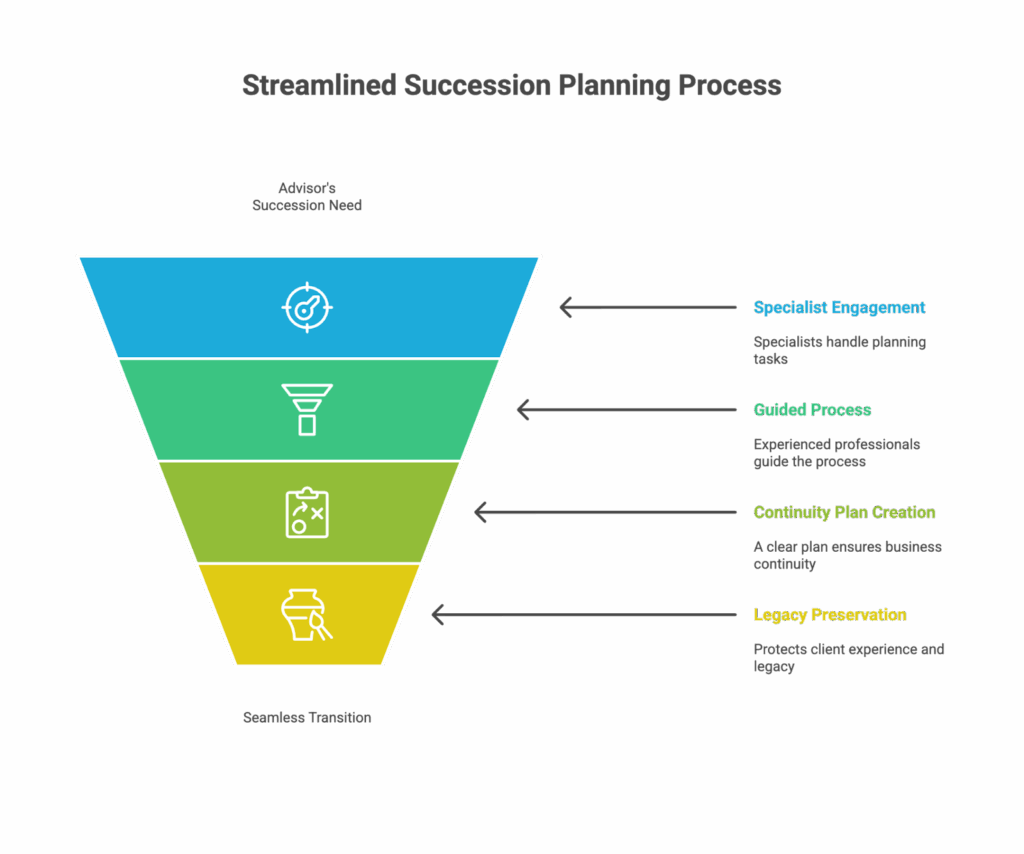
Turnkey succession planning is a packaged solution designed to make the transition process as smooth as possible for financial advisors. Instead of piecing together valuations, potential buyers, legal structures, and client transition plans on your own, the entire succession planning process is handled by specialists.
Traditional approaches often leave the advisor acting as both the business owner and the project manager. That can mean months of searching for a potential successor, negotiating terms, and managing compliance on top of normal client work. In contrast, turnkey planning removes much of that burden by offering a guided process with experienced professionals.
RIAs, wealth management firms, and independent financial advisors often find this path appealing because it creates a clear continuity plan without the operational drain. The goal is simple: ensure a seamless transition that protects client experience, preserves practice management systems, and safeguards the advisor’s legacy.
For firms navigating unique compliance or organizational structures, effective RIA succession planning can be critical to a successful outcome.
Why Advisors Explore Turnkey Solutions
Advisors look to turnkey solutions when the weight of running both client work and succession planning feels unsustainable. Retirement readiness is a major driver. With 37% of U.S. advisors set to retire in the next decade, representing 40% of industry assets, the need for structured transitions has never been greater.
Burnout is another motivator. Constant regulatory requirements, practice management responsibilities, and evolving investment strategies create fatigue. For many financial professionals, a turnkey solution removes stress from an already overwhelming stage of their careers.
Another common reason is the absence of an internal successor. Many firms lack a junior advisor or a younger advisor prepared to take over their responsibilities. Without a clear potential successor in place, owners risk client attrition and business instability.
This dynamic often sparks the debate around internal vs. external succession planning for financial advisors, with turnkey models often serving as a streamlined external option when internal continuity isn’t viable.
Turnkey planning provides efficiency and peace of mind. It reduces the pressure on the retiring advisor, accelerates the timeline, and ensures that both clients and staff experience stability during a critical career-defining decision.
The Pros of Turnkey Succession Planning
One of the strongest advantages of turnkey succession planning is speed. A successful succession plan can move from valuation to execution faster than if the advisor handled each step independently.
Advisors also gain access to a vetted pool of potential buyers. This reduces risk and increases the likelihood of finding a successor who aligns with client expectations and firm values. For a financial advisor concerned about continuity, this matters as much as price.
Another key benefit is built-in expertise. Turnkey providers understand valuation, deal structures, estate planning considerations, and strategies to ensure a successful transition. Their guidance helps the business owner avoid costly mistakes and focus on the outcome rather than the process.
Many advisors unknowingly fall into traps that can derail their exit. Understanding the common succession planning mistakes that financial advisors make can help you navigate your transition more effectively and avoid major setbacks.
Ultimately, the structured approach often results in stronger client retention. Clients see a clear continuity plan, complete with a prepared successor, defined communication protocols, and a focus on maintaining their financial goals. That creates a smoother client experience and helps protect the advisor’s legacy long after retirement age.
The Cons and Tradeoffs
Turnkey succession planning is effective, but it comes with tradeoffs. The most common concern is control. Advisors may feel limited in their ability to influence every detail of the process, especially when it comes to selecting the successor. While buyers are vetted, the advisor does not always receive the same level of personalization as when handpicking a partner or grooming an internal successor.
Cost is another factor. Advisors are paying for expertise, efficiency, and reduced stress. That investment can feel high compared to managing the process independently, though the risks of going solo are often greater.
Finally, turnkey solutions can feel less personal. Advisors who want to shape every part of the transition may find the structure restrictive. For many, though, the benefits outweigh the compromises, especially when the priority is continuity, client retention, and a smoother exit from the business.
How to Know if Turnkey Succession Planning Is Right for You
Turnkey succession planning works best for solo advisors or small firms without a clear internal successor. If you don’t have a junior advisor, a younger advisor, or a family member ready to step in, this model creates structure where none exists.
There are a few clear signs you may need a turnkey approach. If you lack the time or energy to manage the succession planning process yourself, outsourcing it ensures nothing falls through the cracks. If your goal is a compliance-ready exit that reduces operational risk, turnkey planning provides that framework. And if you care more about client continuity and stability than maintaining control over every detail, this solution may be right for you.
In contrast, advisors with a trusted partner succession strategy, or firms with a prepared internal successor, may prefer a traditional plan. The key is fit. Advisors should assess their stage of life, retirement goals, and capacity to manage the process before deciding.
How buyAUM Simplifies the Path
buyAUM acts as a turnkey succession partner for financial advisors preparing for transition. We remove the uncertainty by guiding you through every stage of the process.
Our services begin with accurate practice valuation so you understand what your firm is worth today. We then match you with vetted buyers who align culturally and philosophically with your client base. From there, our team supports negotiations, helps structure deals, and develops strategies to maximize client retention through the transition.
This structured approach reduces risk, protects client relationships, and ensures your legacy carries forward.
The first step is clarity. Start with your free TruValue Report to see what your practice is worth and explore a succession plan designed for your future.
Choosing Clarity Over Uncertainty
Turnkey succession planning provides advisors with a structured, lower-stress approach to prepare for a transition. It creates efficiency, ensures compliance, and protects client continuity during one of the most important decisions of your career.
Your legacy deserves a plan that works, and your clients deserve uninterrupted care.
At buyAUM, we specialize in helping advisors move from uncertainty to clarity. With the right partner and process, you can secure your firm’s future while stepping into the next stage of life with confidence.
Start with your free TruValue Report to understand your value and map out your best path forward.